
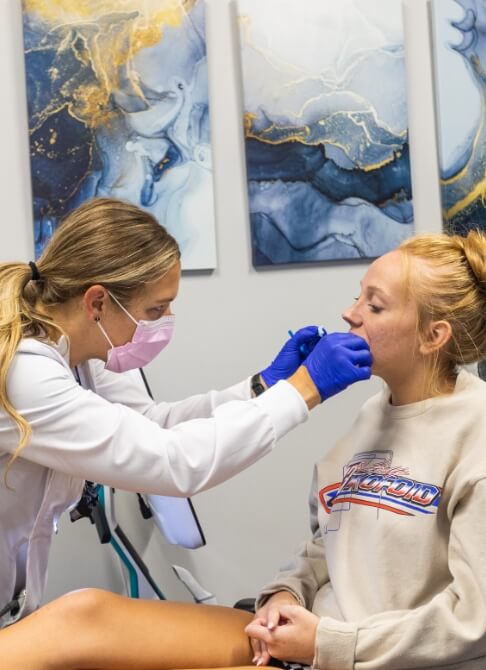
Does your child often breathe through their mouth, or do they frequently suck their thumb or fingers? They might require myofunctional therapy, a service that aims to prevent future problems by training a patient to use their oral structures in the proper way. If you believe that you or your child could benefit from this service, our Mankato team is ready to consult with you so you can lay the foundation for a healthy smile. Get in touch with us today to learn more.
Jane is our secure online scheduling and payment platform for airway services. You can use Jane to conveniently view available appointments, schedule your airway service, and complete payments online. Simply click the button to get started and find a time that works for you.
Myofunctional therapy is a type of physical therapy that aims to correct orofacial myofunctional disorders (OMDs). That sounds like a mouthful, but the basic concept is pretty easy to understand. Essentially, myofunctional therapy trains a patient, whether they are young or old, to use their oral structures in the proper way. For example, it can teach them correct swallowing techniques, encourage them to breathe through their mouth instead of their nose, help them to enjoy a more functional bite, and more.
Myofunctional therapy is often recommended for children who engaged in prolonged thumb sucking or pacifier use. It is also helpful for many individuals who received treatment for lip or tongue tie.
OMDs might not seem like a big deal at first, but they can lead to some serious long-term consequences if they remain untreated. Here are a few possible outcomes of an untreated OMD:
Myofunctional therapy may be paired with orthodontia, tongue tie treatment, or other therapies to produce optimum results. An effective myofunctional treatment plan has the potential to lead to many benefits:
It is also worth noting that myofunctional therapy has an impressive track record of success. Some studies show that it is 80 – 90% effective in correcting rest posture of the oral structures, swallowing, and other functions. The new habits that patients learn are often retained for many years after they complete therapy. It is even possible for myofunctional therapy to provide lifelong benefits!
The cost of myofunctional therapy can depend on a few factors, such as the number of sessions you require and the overall intensity of your care. During your consultation, our team can propose a treatment plan for your unique case and help you understand its price. We do not want you to be overly stressed about the financial aspect of your therapy, so we offer convenient provisions to help you afford it, such as third-party financing and an in-house savings plan.

Some of the biggest factors that can affect the cost of myofunctional therapy include:

Generally speaking, no, dental insurance does not cover myofunctional therapy. Dental insurance is usually limited to treatments that directly affect the teeth and gums, rather than those that affect a patient’s ability to properly use their oral structures. Additionally, our practice chooses not to be in-network with insurance because insurance companies often place stipulations on care that are not in our patients’ best interests.

There are a few provisions that might make your myofunctional therapy more affordable:
Are you interested in learning more about myofunctional therapy and its cost? Contact Hyland Dental in Mankato today to ask questions or request a consultation.
The process of myofunctional therapy begins with an initial assessment. During this stage, our Mankato team will evaluate your child’s oral and facial structures to understand how they are functioning. Our goal is to identify patterns and habits, such as mouth breathing or incorrect tongue posture, that may be affecting your child’s health and development.
After the evaluation, we will develop a personalized treatment plan tailored specifically to your child’s needs. This plan typically includes a series of exercises designed to retrain the oral and facial muscles. These activities promote proper function, which can contribute to improved overall health and reduce the risk of future complications.
Therapy sessions are generally less than one hour in length. The frequency of these sessions may vary depending on your child’s progress and individual requirements. As your child advances through the therapy, we may introduce new exercises and activities to support continued improvement
Depending on your child’s age and ability, you may need to play an active role in helping them keep up with their treatment program.
The duration of myofunctional therapy depends on your child’s unique needs. Some children respond quickly to the exercises and reach their goals in a shorter period, while others may require more time to achieve optimal results. We typically begin with a treatment plan that outlines a specific number of sessions, but this plan can be adjusted as your child progresses. Most courses of myofunctional therapy last at least a few months, although the timeline may be extended for children who need additional support.
Myofunctional therapy is a non-invasive approach and is generally painless. However, your child may experience muscle fatigue and mild soreness as the oral and facial muscles adapt to new patterns of movement. This discomfort is temporary and should diminish as the muscles become stronger. We will monitor your child’s experience closely and make adjustments as needed to promote their comfort throughout the therapy process.
There are several signs that may indicate your child could benefit from myofunctional therapy. For example, many children who have undergone a lip or tongue tie release require this therapy to support proper healing and function. Other indicators include:
If you observe any of these signs, we recommend scheduling an evaluation. Our team will assess your child and determine if myofunctional therapy could be beneficial.
Often, children who are over the age of 5 are old enough to understand how to perform the exercises. However, there are no hard and fast age restrictions. Specialized myofunctional therapy may be available for toddlers and infants. In some cases, teens and adults can also benefit from therapy.
Keep in mind that if you notice signs of an OMD in your child, it is best to bring them for a consultation sooner rather than later. Timely treatment can play a huge role in preventing complications later on.